 how-to
How to Analyze BRRRR Deals for Profit: A Step-by-Step Guide
Last Updated: October 28, 2026
Quick Summary
To analyze BRRRR deals for profit, start with five numbers: purchase price, rehab budget, after-repair value, monthly rent, and refinance terms. Then calculate all-in cost, equity created, cash recovered at refinance, and post-refinance cash flow, and stress-test the deal against a downside case before committing capital.
- Buying below market value creates the equity you later pull out through a cash-out refinance.
- In the example, a $250,000 ARV against a $202,650 all-in cost creates $47,350 in equity.
- The base-case example leaves roughly $17,400 of your own cash in the deal after refinancing.
- Break-even rent in the example sits 22% above market, so the deal should be renegotiated or passed.
- Include vacancy, maintenance, management, and capex reserves in every analysis to avoid overstating profit.
Table of Contents
- Start With the Five Numbers That Decide Every BRRRR Deal
- A BRRRR Deal Analysis Example With Real Numbers
- Building Your BRRRR Deal Analysis Spreadsheet
- When to Use a BRRRR Calculator (and When It Misleads You)
- BRRRR Cash-on-Cash Return and the Metrics That Matter
- Sourcing Off-Market BRRRR Deals That Fit Your Buy Box
- Frequently Asked Questions
Start With the Five Numbers That Decide Every BRRRR Deal
Learning how to analyze BRRRR deals for profit starts with five numbers: purchase price, rehab budget, after-repair value, monthly rent, and refinance terms. Get those wrong and the deal fails no matter how good the property looks.
The BRRRR method (Buy, Rehab, Rent, Refinance, Repeat) recycles capital through a cash-out refinance, but only if you buy below market value and keep rehab costs tight.
Purchase Price, Rehab Budget, ARV, Rent, and Refinance Terms
- Purchase price: Your all-in cost sets the ceiling. Buying below market value creates the equity you later pull out.
- Rehab budget: Build a repair estimate line by line, then add a contingency. Contractors rarely finish on the first number.
- After-repair value (ARV): Pull comparable sales, or sales comps, from the last few months. Three to five close comps beat a guess.
- Monthly rent: Check current rental income against real vacancy rates, not wishful figures.
- Refinance terms: Loan-to-value ratio (LTV), interest rate, and lender fees decide how much cash you recover. Streamlined real estate closings can help you lock in purchase and refinance terms efficiently.
If you need help after closing, post-closing renovation guidance is available.
A BRRRR Deal Analysis Example With Real Numbers
Here is a BRRRR deal analysis example. The point is the structure, not the numbers, swap in your own inputs.
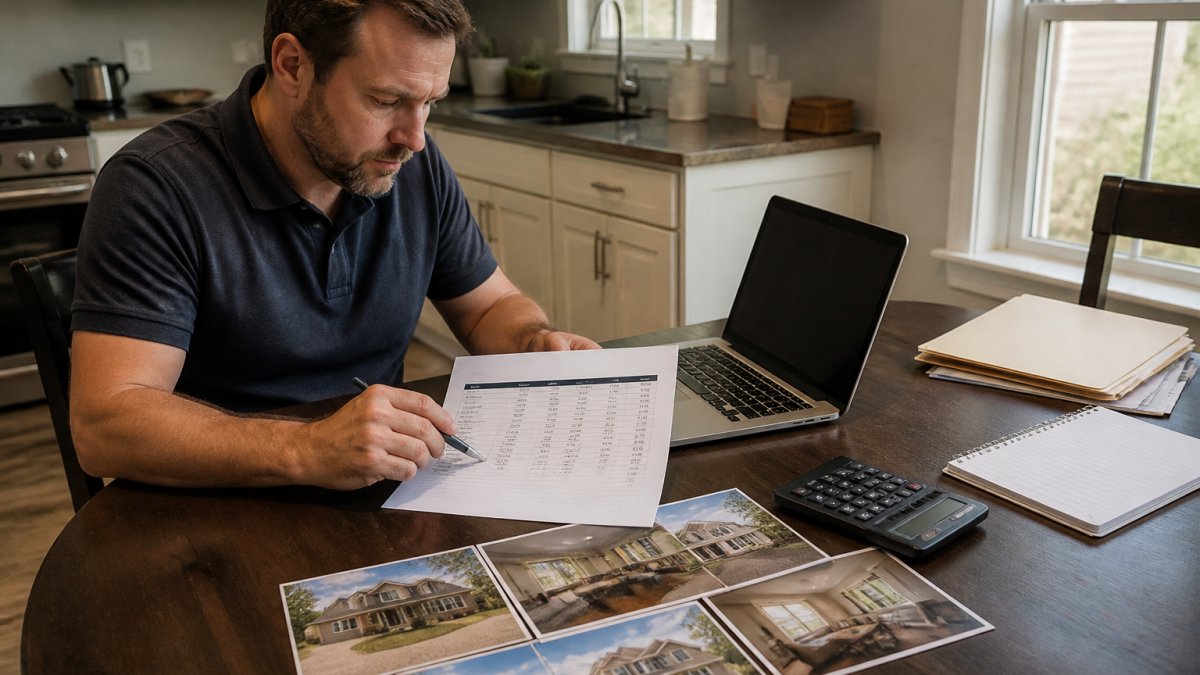
Base-case assumptions
- Purchase price: $150,000
- Rehab budget: $35,000 (line-item estimate plus a 10% contingency)
- After-repair value (ARV): $250,000, supported by three to five closed comps from the last 90 days
- Monthly market rent: $1,850
- Vacancy: 8% of gross rent (roughly one month per year)
- Operating expenses: property taxes $250/mo, insurance $125/mo, maintenance and repairs $150/mo, property management at 8% of collected rent, capital expenditure reserve $100/mo, utilities paid by owner $0 (tenant-paid)
- Refinance: 75% loan-to-value on the ARV, 7.5% interest, 30-year amortization, 2% closing costs
Step 1, All-in cost. $150,000 + $35,000 + $3,500 contingency = $188,500.
Step 3, Equity created. ARV minus all-in cost: $250,000 − $202,650 = $47,350 in equity.
Step 4, Refinance and cash recovered. At 75% LTV on a $250,000 ARV, the new loan is $187,500.
Step 5, Cash flow after refinance. Gross rent $1,850 minus 8% vacancy ($148) leaves $1,702 collected.
The lesson: equity and cash flow are two different wins. Run the same math before you fall in love with the ARV.
Downside and Break-Even Cases
Every projection hides a risk. As AirDNA's BRRRR overview notes, unexpected repair costs and refinancing challenges can undercut your plan to recover capital.
Downside case. Add 20% to rehab ($42,000), cut rent 10% ($1,665), and assume a 5% low appraisal ($237,500 ARV).
Break-even case. Solve for the rent where monthly cash flow hits zero.
Refinance constraints to test explicitly. A low appraisal can reduce your loan and cash recovery. Refinance closing costs also come out of recovered cash. Model these factors before counting on recycling capital.
Building Your BRRRR Deal Analysis Spreadsheet
A BRRRR deal analysis spreadsheet can organize your assumptions. Underwrite operating expenses and refinance constraints, not just headline rent and ARV.
Set up five tabs, and keep inputs visually separate from formulas:
- Inputs: purchase price, rehab line items (with a contingency row), ARV, market rent, vacancy rate, refinance LTV, interest rate, amortization, and closing-cost percentage.
- Operating expenses: property taxes, insurance, maintenance and repairs, property management, utilities paid by owner, HOA dues, vacancy allowance, and a capital expenditure (capex) reserve. Keep each as its own line, every one is a lever you will stress-test later.
- Carrying costs: months of rehab, hard-money or bridge interest, taxes and insurance during the hold, utilities, and any HOA dues while vacant. This tab is where most optimistic models quietly fail.
- Cash flow: collected rent (gross rent minus vacancy) minus operating expenses equals net operating income (NOI); NOI minus debt service equals monthly cash flow.
- Returns: cash left in the deal after refinance, cash-on-cash return, return on capital employed (ROCE), and equity position (ARV minus loan balance).
The formulas that matter. Keep them simple and auditable:
- All-in cost = purchase price + rehab + contingency + acquisition closing costs + carrying costs.
- Equity created = ARV − all-in cost.
- Cash recovered at refinance = new loan amount − payoff of the acquisition/bridge loan − refinance closing costs.
- Cash left in the deal = all-in cost − cash recovered.
- Cash-on-cash return = annual cash flow ÷ cash left in the deal.
- ROCE = annual profit ÷ total capital employed (including capital already recovered).
Underwrite the expenses competitors skip. Modeling only rent and mortgage payment overstates profit. Include:
- Property taxes and insurance at the post-rehab assessed value, not the pre-rehab value.
- Maintenance and repairs at a realistic monthly reserve (many investors use 5-10% of gross rent).
- Property management at the going rate (often 8-10% of collected rent) even if you plan to self-manage, you may not always do so.
- Vacancy at a market-derived rate, not zero.
- Capex reserve for roof, HVAC, and other big-ticket items (often $75-$150 per unit per month).
- Utilities and HOA dues where the owner pays them.
Add a sensitivity block. On the Returns tab, build three columns, base, downside, break-even, and change one assumption at a time: ARV down 5-10%, rehab up 15-20%, rent down 10%, vacancy up, interest rate up 1-2 points, LTV down to 70%. The column that turns cash flow negative or leaves capital stuck tells you which assumption the deal depends on.
Lock the formulas and color-code inputs so you never overwrite a calculation. Save a clean template and copy it for each new deal, that is how the spreadsheet becomes a system, not a one-off exercise.
When to Use a BRRRR Calculator (and When It Misleads You)
A BRRRR calculator speeds up the math, but it only reflects what you feed it. Professional tools break the cycle into four phases: acquisition, rehab and holding, refinance, and rental performance, per DealCheck's BRRRR calculator overview.
Calculators mislead when you trust the defaults. Watch these traps:
- Optimistic ARV: Garbage comps produce garbage equity.
- Thin expenses: Skipping vacancy, maintenance, and management inflates cash flow.
- Ignored carrying costs: Holding costs during rehab eat into returns.
Use the calculator for speed, then sanity-check every input by hand.
BRRRR Cash-on-Cash Return and the Metrics That Matter
BRRRR cash-on-cash return measures annual cash flow against the cash left in the deal after refinancing, the number that tells you whether recycling capital paid off.
Track these alongside it:
- Cash left in the deal: Capital still tied up after the refinance.
- Return on capital employed (ROCE): Profit against total capital used.
- Equity position: ARV minus loan balance.
Cash recovery is the goal. A deal with strong cash-on-cash return and little cash left in it beats a bigger deal with capital locked up.
Sourcing Off-Market BRRRR Deals That Fit Your Buy Box
The best analysis is worthless without a deal to run it on. That is where sourcing matters. Investors in 2026 are shifting toward fewer, cleaner executions with tighter refinancing plans, according to BiggerPockets investor discussion.
Define your buy box first: price range, property type, and target ARV. Then filter every lead against it.
| Stage | What You Check | Why It Matters |
|---|---|---|
| Sourcing | Fits your buy box | Saves hours on bad leads |
| Screening | Purchase price vs. ARV | Confirms equity spread |
| Underwriting | Rehab, rent, expenses | Tests real cash flow |
| Refinance | LTV and lender terms | Sets cash recovery |
| Hold | Cash-on-cash return | Measures ongoing profit |
At Steven Wesolowski, we match investors to off-market inventory based on their criteria. Backed by a $17 billion nationwide network, we provide access to off-market inventory and personalized deal matching.
Frequently Asked Questions
How do you calculate profit on a BRRRR property?
Profit on a BRRRR comes from two places: equity captured at purchase and rehab, and ongoing cash flow. Add the after-repair value minus your all-in cost (purchase price plus rehab plus closing and carrying costs) to get equity created. Then subtract full operating expenses, vacancy, and debt service from monthly rent to get cash flow.
What is a good BRRRR cash-on-cash return?
Cash-on-cash return divides annual pre-tax cash flow by the cash you left in the deal after refinancing. Because BRRRR aims to recover most of your capital, the denominator shrinks and the percentage can look inflated. Focus on the dollar amount of cash flow and the cash left in the deal together. A property returning 8% on $40,000 left in is a different outcome than 8% on $5,000 left in, even though the headline number matches.
How do you estimate the after-repair value of a BRRRR property?
Pull comparable sales and consider differences in bed count, bath count, square footage, and condition. Overstating ARV can leave more capital in the deal than planned.
How does refinancing affect BRRRR cash-on-cash return?
Refinancing resets both sides of the ratio. A cash-out refinance can replace short-term financing with a longer-term loan. It can return capital, shrinking the cash left in the deal and raising the cash-on-cash percentage. Run the math at several LTV levels, because a lower appraisal can reduce how much capital you recover.
Analyzing BRRRR deals for profit comes down to discipline: five numbers, honest expenses, and a downside case you can survive. If sourcing qualified deals is slowing you down, Steven Wesolowski can help. We offer exclusive off-market inventory, personalized deal matching, and post-closing renovation guidance, all with military-grade precision. Get started with Steven Wesolowski and turn analysis into closed deals.